Once the novelty of the spinning wheel activities wears out, or if the questions seem just a little bit out of reach, how do you motivate your child to keep going?
Everyone has their own approach to learning motivation, and it depends on the multitude of things that are unique for each family and each child. So there are no right or wrong answers. In our family, we don’t pay for homework, but we pay money plus ‘interest’ for completion of the spinning wheel.
Let me break it down for you. First, why don’t we pay for homework?
Many educational experts suggest so. They say that kids should feel inherent pleasure in work well done, a sense of pride and accomplishment, which can be overpowered by money. Also, they say adults should not to micromanage their kids’ homework. There are a lot of skills, such as remembering about homework, finding time to do it, figuring out how to do it, and patiently completing it – and these skills will be useful in high school, university, and the workplace. Experts recommend that parents devise other rewards for ‘work well done’.
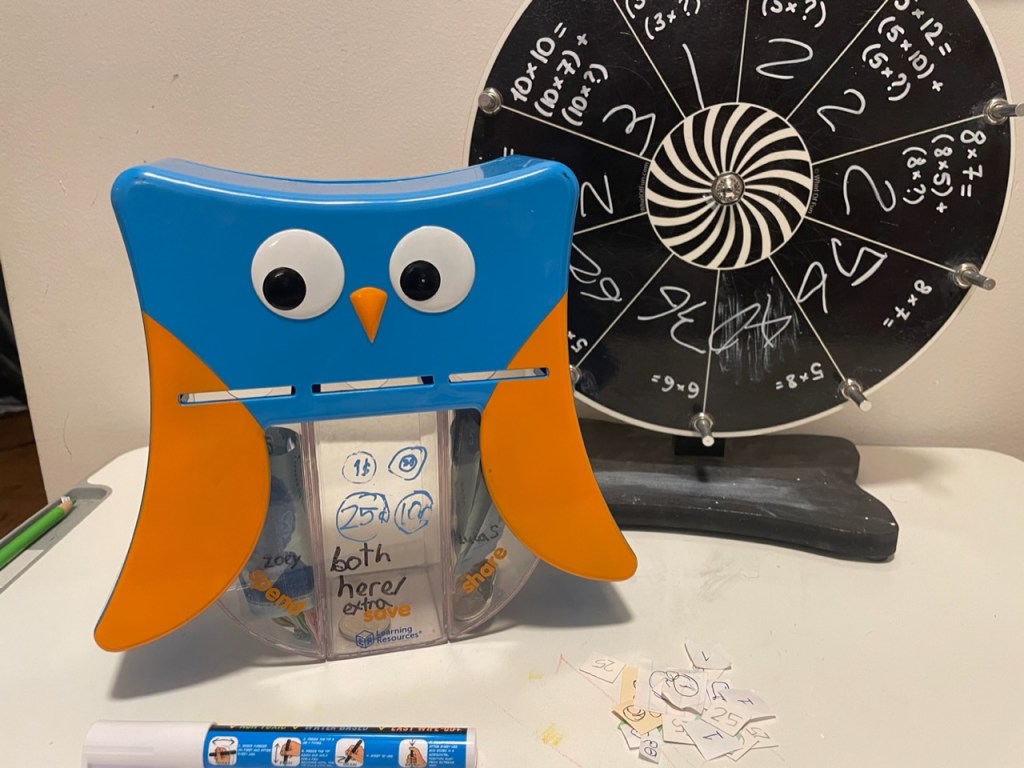
Okay, then, why do we pay for completion of the spinning wheel?
Because it is not homework. It is not tasked by someone else, who has a separate relationship with your child. It is not a house chore, which both parents and children do for free. It consists of repetitive, mechanical tasks with no creative potential. And because, ultimately, learning should be, over time, profitable.
We took a learning-that-begets-learning approach. In sum, kids do their work daily, receive substantive rewards intermittently, and get token rewards daily. The token rewards (the ‘interest’) can be added up, exchanged into money over time, and compounded.
As long as they do their spinning wheel diligently every day, I would sometimes randomly give them $1. If you know psychology, you will know this as variable reinforcement or intermittent reward schedule, an effective rewards system producing dopamine spike and persistent behaviour pattern. So, sometimes they will get money two days in a row, other days they will have to wait for longer than a week, but on average, I would aim for about $1 per week.
Kids would put money into their ‘bank’. For every $1 that stays in the bank, every day I would pay them ‘interest’ – a piece of paper with (1) on it. And for days when they have some extracurriculars and still find time to do their spinning wheel, I would pay them double the interest. Once they have a certain amount of ‘interest’, it gets converted into real money, for example, a quarter.
Overall, I aim to have an ‘exchange rate’ where my kids earn about a quarter per week – which means that exchange rate changes over time. In kindergarten, before the bank builds up solid savings, the ‘interest rate’ might be (10) or (20), and in grade 4 the ‘interest rate’ might be (200).
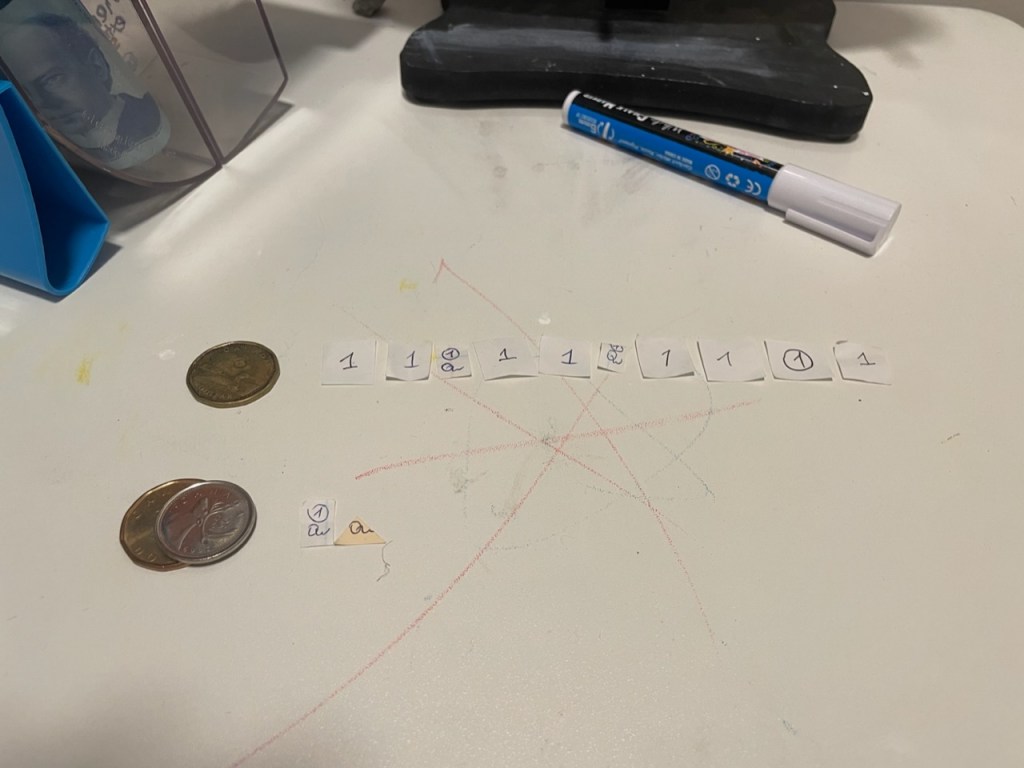
The picture is meant to illustrate the compounding. For every $1 in the bank, you get interest of (1) every day. If the interest exchange rate is 10, then interest of (10) can be exchanged for a quarter. Then you have $1.25 in the bank, and receive (1)+(1/4) everyday.
There are multiple learning outcomes here. Kids have to add up all the papers, which come in denominations like (1/4), (1/2), (1), (3), (4), (5), (10), and (25). Kids also learn to save and resist spending. Of course, you can take $2 and spend it on cookies at recess, but you will have less interest and it will take you quite some time to earn it back.
That’s what’s been working so far for us. How do you guys motivate your children to learn? Do you have any successful strategies – or lessons learned – that you could share?


Leave a Reply