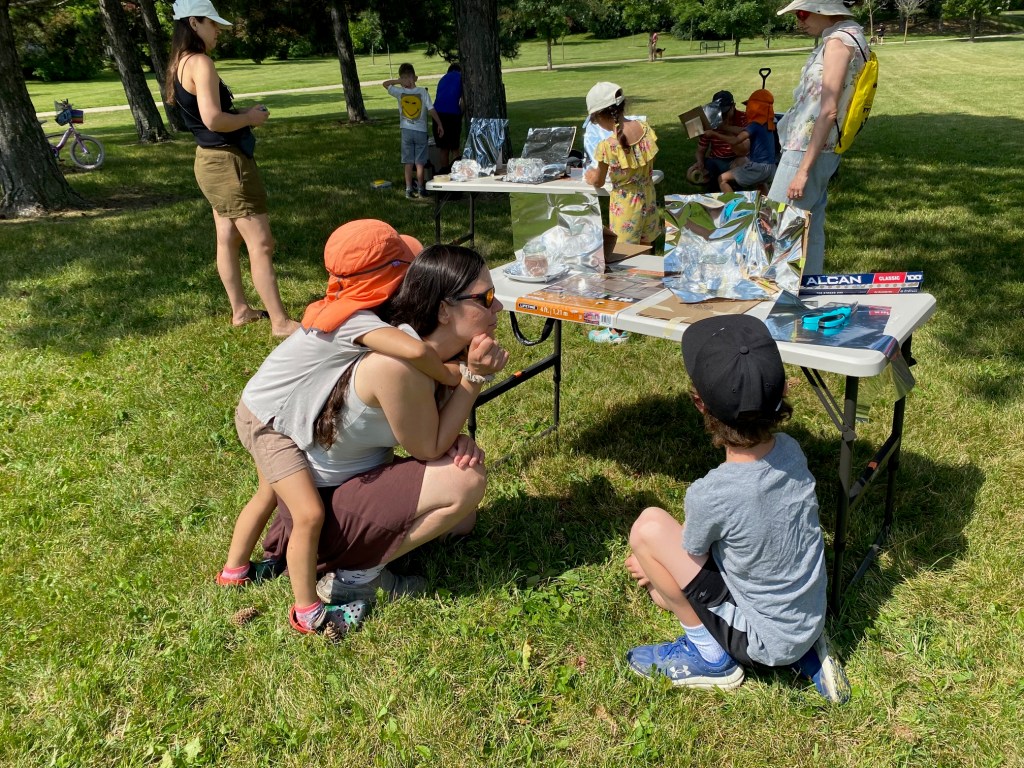
In late spring and early summer, although the summer heat has not yet arrived, the Sun is highest above our heads. We often don’t think what that means. But it means it’s the season for solar cooking in the park!
Solar cooking is a great skill to learn. Just the sheer magic of cooking food with, literally, zero carbon inputs, might be enough! But it is not only a great emergency preparedness skill, it is a great lifehack for those oppressively hot days when cooking indoors seems like a bad idea. Not only there is no added heat inside your house, but whatever sun’s warmth you consume is no longer available to warm up the planet.
But can you really use sun’s warmth to cook something, without using any electricity? At all? Sure, sun is warm, but can it really heat something up to boiling?
We have made hot chocolate, and we can confirm: with good design and good sun, it does indeed become very hot, surprisingly quickly!
How does sun send its warmth to the Earth? If shiny surface can redirect sun’s warmth, how do we design a contraption that will redirect the most warmth to our cup of hot chocolate? Can the same trick work with regular milk, or does black colour absorb more warmth than other colours? How can we trap the heat and avoid losing it to the gentle breeze? A thermometer and some simple supplies can help conduct many of these experiments.
If we set out our solar cookers in perfect alignment with the sun, what will happen to our perfect alignment in 30 minutes? What time of day is best for solar cooking? Would solar cooking work in the middle of a winter, and how could we make it work? A globe and a flashlight can answer a lot of these questions in a very intuitive fashion.
If black colour absorbs more warmth than other colours, and if we don’t like oppressive summer heat, why do we live among black asphalt and black roofs? What effect does snow and ice glaciers have on the warmth of the planet, and what is the effect of their melting? What changes can we, with our small hands, make to the environment around us to make it a little bit more pleasant?
After a perfectly clear morning, why do clouds so often appear in the afternoon and hinder our solar cooking? Which way will the clouds move over time, and why? Speaking of clouds, when it’s cloudy, could we do solar cooking with a flashlight?
How hot could a solar cooked meal get, and what could we change to make it even hotter? Can we improve the design of our solar cooker for winter?
What could you cook with the Sun? How is cooking with the Sun different from cooking in an oven?
While we are waiting for our brownies or pizza, we can also talk about the Sun itself. How hot is it? Does the Sun always have the same face turned towards us, like the Moon? What do we know about the Sun? What most valuable things in our society we enjoy thanks to the Sun or other stars? We can even use our telescope, with a special solar filter, and study the Sun in detail.
Every Solar Cooking workshop participant is required to wear good sunglasses. Good sunglasses means UV filter and (ideally) an infra-red filter; cheap plastic ones just suppress the blinking reflex and can actually cause more harm than good. There will be lots, lots, of reflected light, including UV and IR light, from the reflective mylar, and those can be damaging from repeat exposure. A limited number of good quality Julbo sunglasses, smaller size, may be available to be borrowed for the duration of the session.

