Along with the beginning of the school year, September drifts in with early, bedtime-friendly sunsets, bigger harvest moons, and warm nights. This is the time of the year to pull out binoculars, telescope, and look up!
The idea behind the Astronomy series is to give children a reason to look at the Moon and the stars a couple of times within the month. Don’t worry, we will not run out of space-related things to do and talk about!
What do you think we will see? The Moon is always in the sky at night, right? Actually, no, we will see a total chaos! In the evening two weeks ago, the moon was half-hidden and setting in the west; two weeks later, it is a full moon, rising in the east; and a week later yet, it will be rising in the morning and setting in the afternoon, completely invisible in the sunny skies!
We don’t have to pay much attention to the Moon in our day-to-day. But our ancestors did; to them, the Moon was an important source of time-keeping. If you were trying to plan your activities for the next season, or getting ready for a big celebration 6 months ahead, counting by days would lead you to many errors – but if you understand the rhythms of the Moon, counting full moons would always be easy.
The Moon is also the hidden engine of the oceans. Science suspects that early living beings were able to adapt to living on land thanks to the gentle refreshers of the tides. An important battle of the Second World War, Tarawa, was almost lost due to miscalculation of the tidal water flow in the Pacific Ocean.
The Moon is also the farthest place humans have ever stepped foot. We can talk about how many people actually have been to the Moon, how long the trip took, and what is different about flying in the space compared to flying in the Earth’s air, and we can even taste freeze-dried peaches that Neil Armstrong ate during his historic first visit. We can look at the pictures from the Moon mission and discuss how the Moon is different from the Earth. Is it flatter or more mountainous than the Earth? Is its sky blue? If the Moon does not have air or water, what other things will look and feel different on the Moon?
While we are standing in Toronto and looking at the Moon, can someone halfway across the world see Moon at the same time or within a few hours? Will the Moon look the same to them? Will it look the same to us tomorrow, or next year, or in a 100 years? Is there any place on the Earth where you would not be able to see them Moon? What about Neil Armstrong standing on the Moon – would the Earth look the same to him today, tomorrow, and in a 100 years? Are there places on the Moon where you would not be able to see the Earth?
We can also look at the other heavenly bodies. Venus, the evening star, and its phases, has a different rhythm. Depending on the air pollution, we may be able to see other planets. How can we tell the stars from the planets? We can better understand cosmic distances. How far are the other planets from us, relative to the size of our planet? We can also talk about gravity. How does the rotation work from the perspective of gravity?
Of course, we will not be trying to cover all of these topics in one workshop. Especially with 7-12 year old children, the point is to share some of these perspectives, and give them a sense that there is more there for a curious eye.
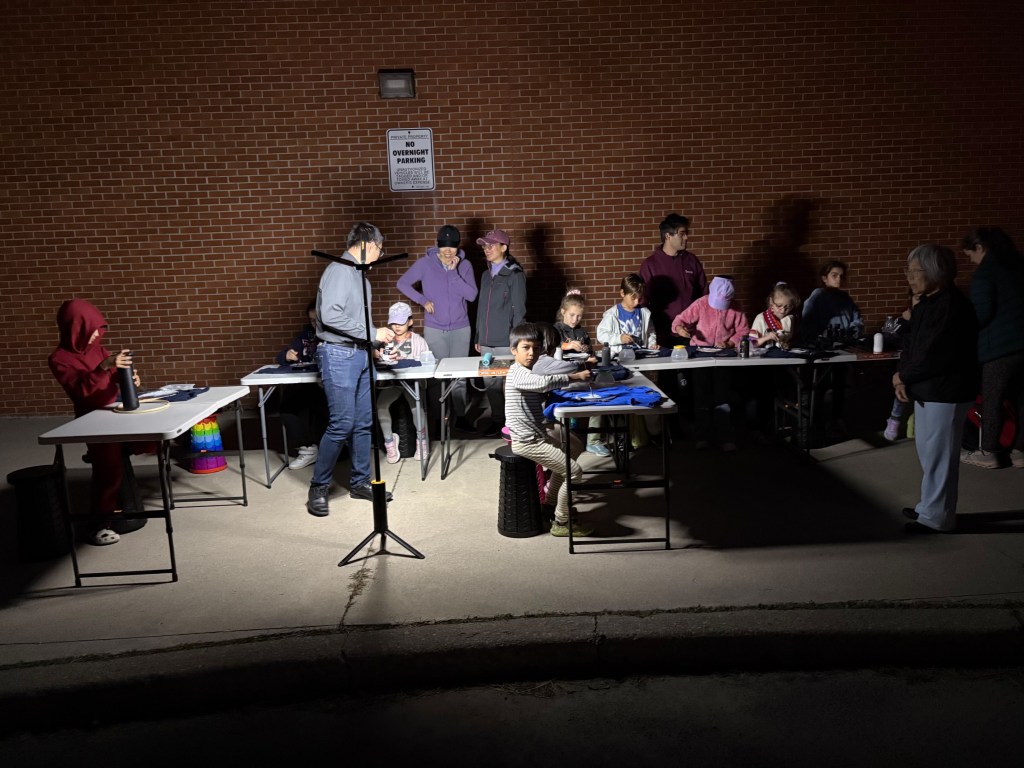
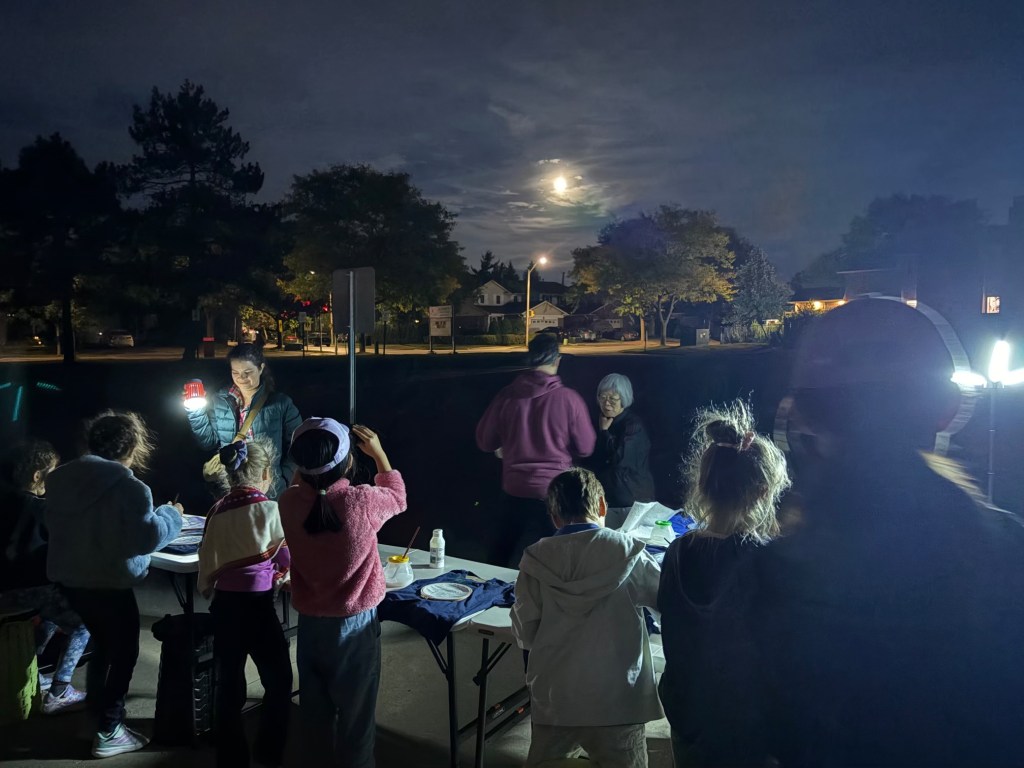
If there was nothing else to it, children would find it hard to just stand around and listen. So the workshops will involve some hands-on activities: painting t-shirts with fabric paint with the image of the Moon as we see it, learning about optics and making simple telescopes, which are similar to the fancy store-bought ones.